
Hope
أمل
Amal · Canaanite Star · All Palestine
The video
The concept
Hope (Amal) is not optimism. Hope is a practice of orientation: the deliberate choice to face forward even when forward is obscured. It is a direction maintained through uncertainty.
الأمل ليس تفاؤلًا. الأمل هو ممارسة التوجه: الاختيار المتعمد للنظر إلى الأمام حتى حين يكون الأمام غامضًا. إنه اتجاه نحافظ عليه وسط عدم اليقين.
The pattern
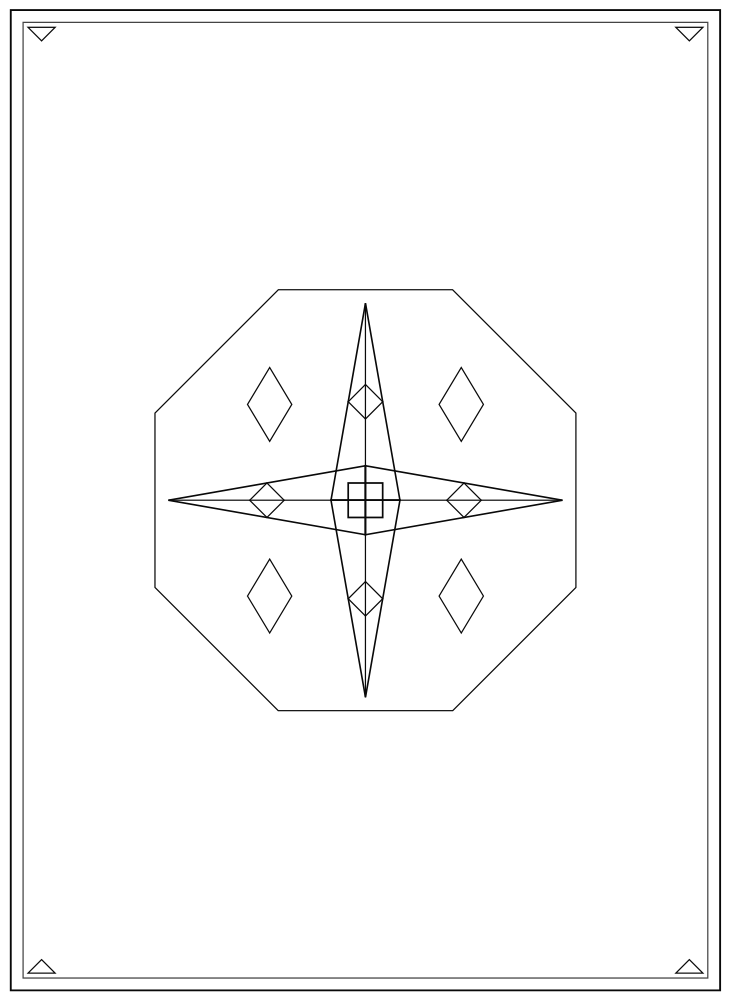
Canaanite Star reaches outward from its center in four long diamond arms — one for each direction of the horizon. Hope is directional like this: it is not a feeling held inside but a reach extended outward, a movement toward the unconfirmed future. The Canaanite Star is pan-Palestinian, found from Gaza to Jenin. This universality is itself a form of hope: a shared geometry that crosses every division.
نجمة كنعان تمتد للخارج من مركزها في أربعة أذرع معينية طويلة — واحد لكل اتجاه من اتجاهات الأفق. الأمل اتجاهي بهذه الطريقة: ليس شعورًا يُحتجز بالداخل بل امتداد يمتد للخارج، حركة نحو المستقبل غير المؤكد.
Color this pattern on page 14 of the book.
How to color it
Begin at the center square
Fill the small center square — your primary red.
Work the four long diamond arms
Each arm is one continuous fill from center to tip — use a single color per arm.
Add the mid-arm diamonds
The small diamond at the midpoint of each arm — accent gold.
Fill the diagonal outer diamonds
The four diagonal diamonds at 45° — contrasting color to the arms.
Complete the outer polygon ring
The final enclosing ring — your darkest color.
Suggested palette
#ff0000#ffd700#f5f0e8#0a0a0a
Cultural significance
Canaanite Star (Najmat Kan'an) is one of the few truly pan-Palestinian motifs — appearing in documented thobes from every region of historic Palestine, from the coastal cities to the inland mountains, from the Jordan Valley to the Negev. This universality makes it one of the most significant patterns in Palestinian Tatreez: a shared visual language that crossed every regional and community boundary.
The name 'Canaanite' situates the motif within the deep history of the land — the Canaanites were the Bronze Age inhabitants of Palestine, and their artistic tradition of geometric ornament is one of the oldest continuous visual traditions in the region. Palestinian embroiderers naming a stitch after this ancient people were making a claim about continuity: this pattern has been in this land for a very long time.
The red and gold palette of the Canaanite Star is among the oldest documented color combinations in Palestinian Tatreez, appearing in fragments dated to the Ottoman period. Gold — achieved through the use of saffron-yellow silk — was the most expensive color in the Palestinian palette, reserved for the most important garments and the most significant motifs. The Canaanite Star's use of gold reflects its status as a high-prestige pattern.
Reflection
What does hope look like as a daily practice — not a feeling but an action?
Write your answer on page 16 of your book.