
Nostalgia
حنين
Hanin · The Central Mukahhala · Ramallah
The video
The concept
Nostalgia (Hanin) in Arabic carries a depth the English word does not reach. From the root hanna — to long, to yearn — Hanin is not sentimentality but a form of love directed toward what has been lost. For Palestinians, Hanin is a political emotion as much as a personal one: the longing for the land, the village, the house, the specific smell of a particular olive tree in spring.
الحنين بالعربية يحمل عمقًا لا يصله الاسم الإنجليزي. الحنين ليس عاطفة وجدانية بل شكل من أشكال الحب الموجه نحو ما فُقد. للفلسطينيين، الحنين عاطفة سياسية بقدر ما هي شخصية.
The pattern
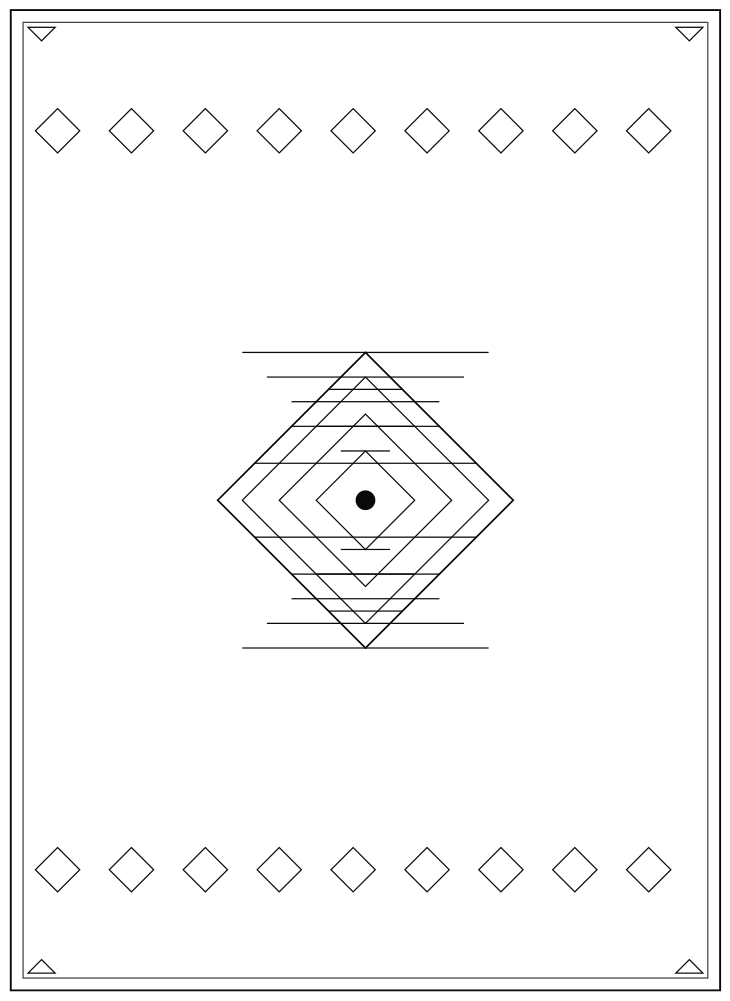
The Central Mukahhala is a deep vessel — a large diamond that holds smaller shapes within it, layer after layer. Hanin works this way: it is not one longing but many lonelinesses layered inside each other, the longing for the house containing the longing for the kitchen containing the longing for the smell of the bread. The Mukahhala holds everything. It is named for kohl — the cosmetic that Palestinian women applied to make the eyes see more clearly, to make what is precious more visible.
المكحلة المركزية وعاء عميق — معين كبير يحتضن أشكالًا أصغر بداخله، طبقة تلو طبقة. الحنين يعمل بهذه الطريقة: ليس اشتياقًا واحدًا بل وحدات متعددة متراكمة داخل بعضها. المكحلة سُمِّيت باللكحل — مستحضر التجميل الذي وضعته النساء الفلسطينيات على أعينهن لجعل ما هو ثمين أكثر وضوحًا.
Color this pattern on page 18 of the book.
How to color it
Begin at the center diamond point
Start filling from the topmost point and work downward.
Fill the large central diamond
Work the main diamond form in your primary color, section by section.
Add the internal horizontal layers
Each horizontal line within the diamond marks a color transition — use 2-3 shades of the same color.
Work the triangular caps
The pointed forms at the very top and bottom — fill in your accent color.
Complete the small border diamonds
The decorative small diamonds along the top and bottom edges.
Suggested palette
#b22222#000000#f5f0e8#0a0a0a
Cultural significance
The Central Mukahhala (al-Mukahhala al-Markaziyya) takes its name from kohl — the dark cosmetic applied to the eyes across Palestinian and broader Arab culture. Kohl was applied with a thin stick in a steady, precise, unrepeatable stroke: a single line that could not be corrected once drawn. The embroidered Mukahhala encodes this quality of the irreversible precise act in geometric form.
Ramallah (Ram Allah, Height of God) is situated in the central Palestinian highlands and has been a center of Palestinian cultural and commercial life for centuries. Ramallah Tatreez is distinguished by its saturated red against white — the most high-contrast combination in the Palestinian palette — and by its use of the Mukahhala as the primary chest panel motif of wedding and ceremonial garments.
The Mukahhala's layered internal structure has been interpreted by Tatreez scholars as a form of visual poetry: each horizontal band within the central diamond is a 'line' of the pattern, and the full composition is a 'poem' of accumulated lines. Palestinian women who could execute the Mukahhala with perfect horizontal alignment and consistent diamond spacing were recognized as masters of their tradition.
Reflection
What specific thing do you carry nostalgia for — not a general past, but one specific detail?
Write your answer on page 20 of your book.