Dignity
كرامة
Karama · Pasha's Tent · Hebron
الفيديو
المفهوم
اللكرامة تعني الشرف والاحترام والقيمة — للكن اللكرامة ذاتية، لا ممنوحة. لا يمكن لسلطة أن تمنحها وبالتالي لا يمكنها سلبها.
Dignity (Karama) means 'honor,' 'respect,' and 'worth' — but karama is inherent, not conferred. It cannot be given by an authority and therefore cannot be taken by one. Palestinian dignity has survived conditions specifically designed to destroy it. This is the proof that karama is structural, not situational.
النمط
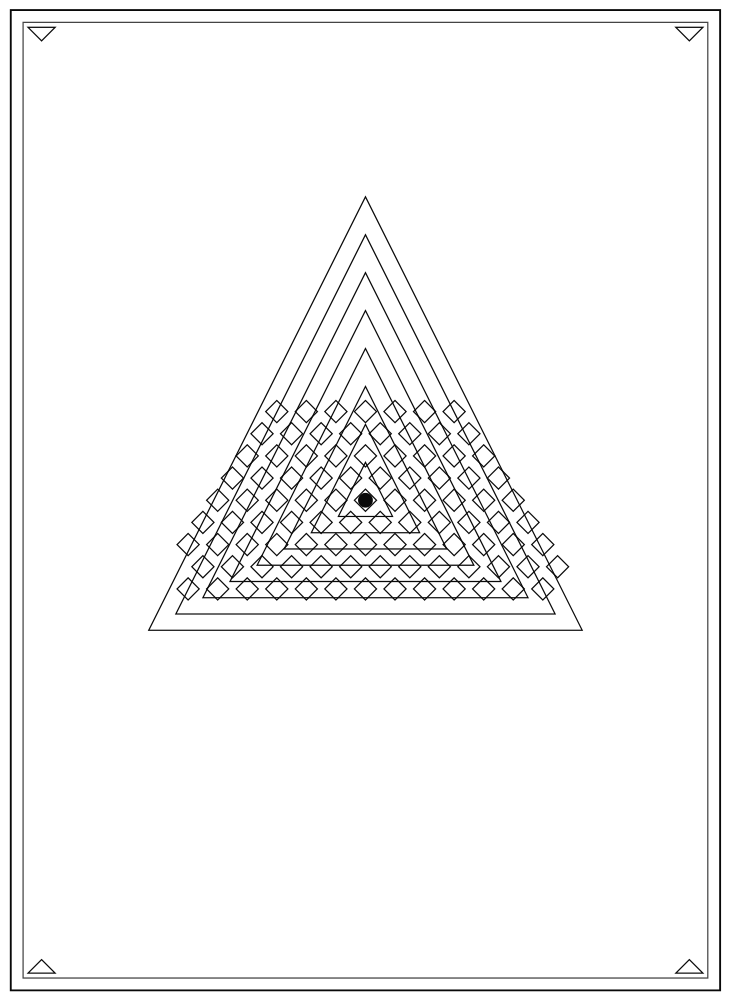
خيمة الباشا ترتفع في طبقات متداخلة من المركز للخارج — كل طبقة مأوى أكبر من السابقة. هذه هي اللكرامة: لا يمكن سلبها لأنها لا تأتي من الخارج. الذات الداخلية الخاصة هي المصدر؛ الطبقات الخارجية تعبيرات لا أسس.
The Pasha's Tent rises in nested layers from the center outward — each layer a larger shelter than the one before, the smallest innermost, the largest outermost. This is Karama: dignity that cannot be taken because it does not come from the outside. The innermost private self is the source; the outer layers are expressions, not foundations. You can strip the outer layers and the center remains. Hebron's embroiderers chose the most demanding interior fill for this motif: the diamond network that proves the shelter is real.
لوّن هذا النمط في الصفحة 34 من الكتاب.
كيفية التلوين
هذا القسم متاح باللغة الإنجليزية فقط.
Begin at the outermost triangle
Fill the largest outer triangle lightly — this is the context, the shelter.
Work inward triangle by triangle
Each nested triangle is a slightly deeper version of the same color — build toward the center.
Fill the inner diamond mesh
The small diamonds within the triangles — a contrasting accent color.
Add the center anchor point
The filled dot at the very center — your deepest color.
Complete the outer border
The frame that contains the tent within the page.
لوحة ألوان مقترحة
#800000#ffffff#f5f0e8#0a0a0a
الدلالة الثقافية
هذا القسم متاح باللغة الإنجليزية فقط.
The Pasha's Tent (Khaymat al-Basha) is documented primarily in Hebron Tatreez. The elaborate tent structures of Ottoman-era governors and military commanders were a powerful visual presence in Palestinian cities, and the motif reflects the architectural grandeur that Hebron's women observed and encoded in thread. 'Pasha' is the Ottoman title for a high-ranking official; the tent is the most elaborate temporary structure in the landscape.
The internal diamond fill (Mainat) of the Pasha's Tent motif is among the most technically demanding elements in Palestinian Tatreez. Each small diamond within the tent interior must be counted precisely — identical in size and spacing across the entire triangular area — and the slightest deviation from regularity becomes immediately visible. The fill proves the shelter is real.
The Hebron Tatreez tradition is characterized by the most restrained palette in Palestinian embroidery: deep burgundy on white linen, with occasional black accent. This restraint is not poverty of imagination; it is the aesthetic choice of a culture that understood dignity as expressed through control. The Pasha's Tent in Hebron colors carries the same message as the actual pasha's tent: this is not decoration, this is power.
تأمّل
هذا القسم متاح باللغة الإنجليزية فقط.
Where do you find your sense of inherent worth — what do you know about yourself that cannot be taken?
اكتب إجابتك في الصفحة 36 من كتابك.