Purity
نقاء
Naqa · Jerusalem's Slab · Jerusalem
Le texte du livre est présenté en anglais et en arabe. Une traduction française intégrale est à venir.
La vidéo
Le concept
Purity (Naqa) is not sterility — it is clarity of essence. The Arabic root naqiya means to be clear, transparent, unblemished. Jerusalem's embroidery tradition is the most formally restrained in Palestinian Tatreez — its patterns the most architecturally precise. This restraint is purity chosen deliberately.
النقاء ليس عقمًا — بل هو وضوح الجوهر. تقليد القدس في التطريز هو الأكثر ضبطًا رسميًا — أنماطه الأكثر دقةً معمارية.
Le motif
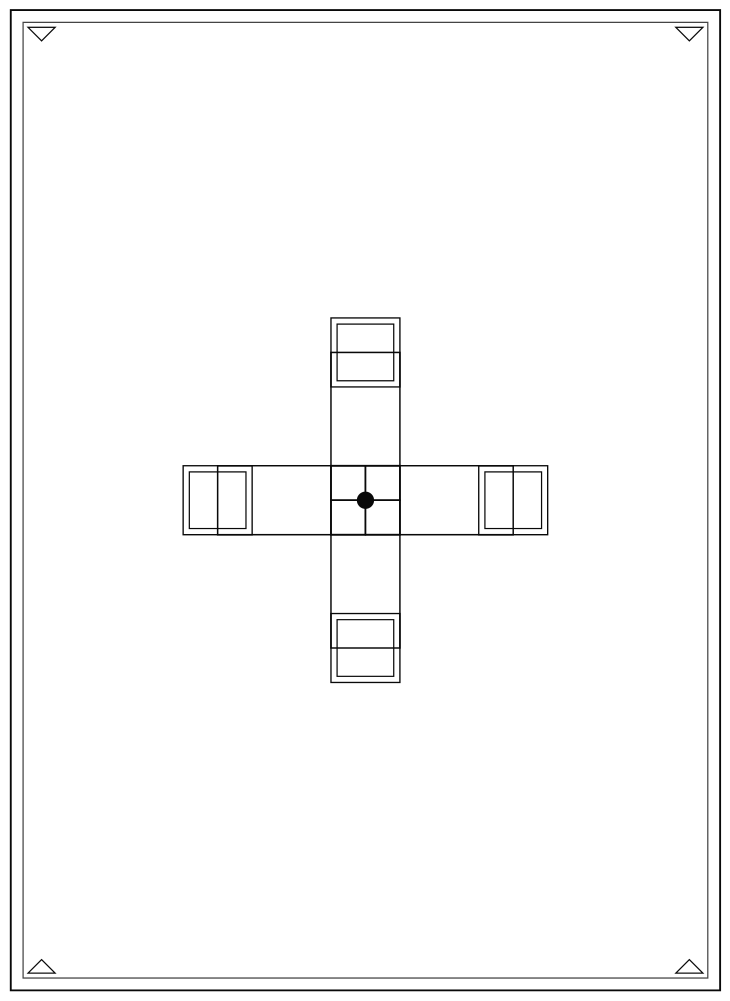
Jerusalem's Slab extends four decorated arms from a central square — one arm for each direction, each ending in its own completed square. Naqa is this structure: a center that holds while four directions of clarity extend from it, each one ending in a completed, bounded, defined form. Jerusalem's embroidery is the most architecturally restrained in the Palestinian tradition — its patterns the most precise, its palette the most controlled. This restraint is not poverty; it is purity chosen deliberately.
سمينة القدس تمتد بأربعة أذرع مزخرفة من مربع مركزي — ذراع لكل اتجاه، كل منها ينتهي بمربعه المكتمل الخاص. النقاء هو هذا البناء: مركز يصمد بينما تمتد منه أربعة اتجاهات من الوضوح.
Coloriez ce motif à la page 54 du livre.
Comment le colorier
Start at the center square
Fill the central square — your primary color.
Work each arm from center outward
Fill each rectangular arm one at a time — same color as center.
Fill the terminal squares
The square at the end of each arm — contrasting accent color.
Add the inner arm details
Any decorative lines within each arm — fine lines in a complementary color.
Complete the boundary
The subtle outer ring that frames the full cross.
Palette suggérée
#ffffff#90ee90#f5f0e8#0a0a0a
Signification culturelle
Jerusalem's Slab (Samina al-Quds) takes its name from the specific pattern used in the most formal Jerusalem embroidery — the Qabbeh chest panel of Jerusalem wedding and ceremonial thobes. The cross-shaped structure with four decorated arms reflects Jerusalem's position at the intersection of four directions, four religions, and four civilizations that have shaped the city's identity over millennia.
Jerusalem (al-Quds, the Holy) is one of the most contested and most sacred cities in human history — holy to Judaism, Christianity, and Islam, the site of the Temple Mount/al-Haram al-Sharif, the Church of the Holy Sepulchre, and the Dome of the Rock. Palestinian embroiderers from Jerusalem worked with white and pale green — colors that reflect the specific quality of Jerusalem's limestone light: clear, cool, architectural.
The Jerusalem Tatreez tradition is the most formally restrained in the Palestinian spectrum. Where other regions use maximum color saturation, Jerusalem uses controlled contrast. This restraint is an aesthetic choice that encodes a specific understanding of quality: in Jerusalem's tradition, the skill of the embroiderer is visible in the precision of the work, not the abundance of color.
Réflexion
What would become clearer in your life if you removed what is unnecessary — what is the essential thing?
Écrivez votre réponse à la page 56 de votre livre.