
Wisdom
حكمة
Hikma · Clock of Bethlehem · Bethlehem
The video
The concept
Wisdom (Hikma) is the knowledge that has been tested by experience and found to hold. The Arabic root hakama means to judge, to govern, to put in order. Wisdom is what remains after the unnecessary has been removed — not the accumulation of information but its distillation into principles that guide action.
الحكمة هي المعرفة التي اختبرتها التجربة ووجدتها صامدة. الجذر حكم يعني الحكم والإدارة. الحكمة هي ما يبقى بعد إزالة غير الضروري.
The pattern
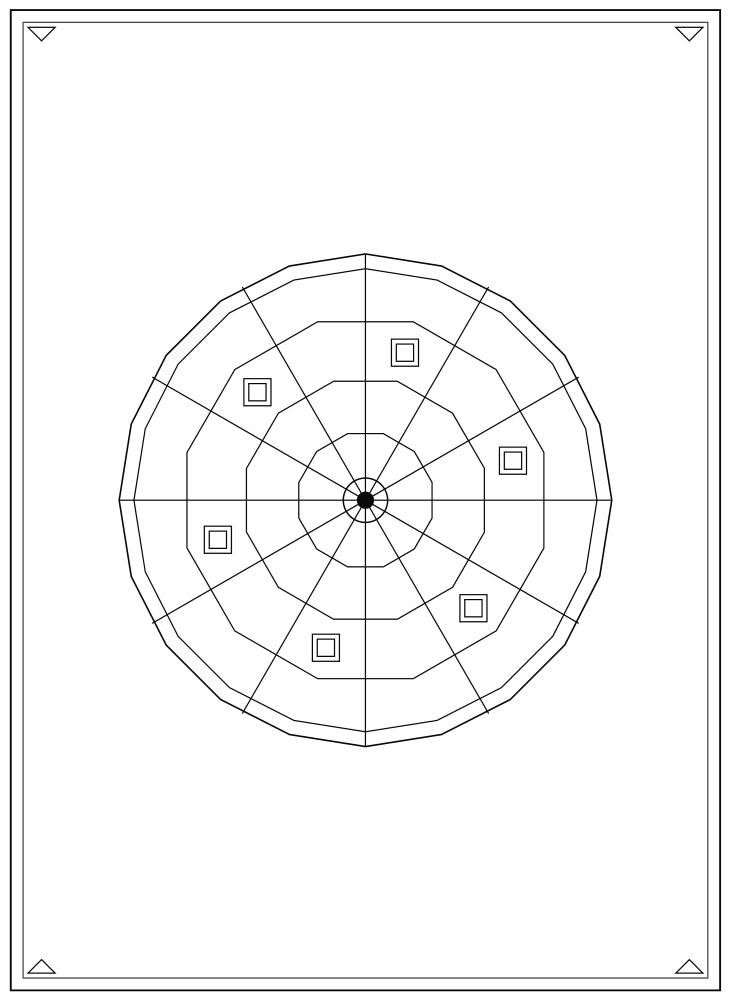
The Clock of Bethlehem divides the full circle into twelve equal sectors from the center — time made visible, time made just, time given equal weight in every direction. Hikma is this: not the accumulation of knowledge but its organization into principles that hold. The clock arrived in Bethlehem in the late 19th century, and Palestinian women immediately encoded it in thread — taking ownership of the measurement of time, translating the new technology into the oldest language they knew.
ساعة بيت لحم تقسم الدائرة الكاملة إلى اثني عشر قطاعًا متساويًا من المركز — الوقت مرئيًا، الوقت عادلًا. الحكمة هي هذا: ليس تراكم المعرفة بل تنظيمها في مبادئ صامدة.
Color this pattern on page 66 of the book.
How to color it
Fill the center circle and dot
The still point at the center — your deepest, most anchored color.
Work the 12 radial lines outward
Define the sector boundaries from center to rim.
Fill alternating sectors
Odd sectors in primary, even sectors in secondary — the alternation creates the clock's visual rhythm.
Add the square accents
The small squares in alternating sectors near the rim.
Complete the polygon rim
The outer boundary ring — your darkest, most grounding color.
Suggested palette
#ff0000#32cd32#f5f0e8#0a0a0a
Cultural significance
The Clock of Bethlehem (Sa'at Bayt Lahm) encodes the mechanical clock's arrival in Palestinian domestic life in the late 19th century. The Hejaz Railway brought new technologies and new time disciplines to Palestinian towns, and the mechanical clock — which enforced a standardized, divided time on communities accustomed to solar and prayer-call timing — was one of the most culturally significant of these new objects.
Palestinian women's embroidery response to the clock was immediate and creative. Within years of the mechanical clock's arrival, the clock face appeared in Tatreez from Bethlehem. This was not passive absorption of a new technology but active translation: Palestinian women took the imported object and encoded it in their own language, placing the clock face within the geometric framework of Palestinian ornamental tradition.
The 12-sector division of the clock face on a circular ground is a mathematical achievement in cross-stitch. The circle must be approximated through a polygon, and the 12 equal divisions must be calculated and maintained across the radial composition. The embroiderer who can execute this perfectly has demonstrated geometric wisdom — the wisdom of being able to bring order to what would otherwise be chaos.
Reflection
What experience has given you the most wisdom — what did you learn that you could only learn by living through it?
Write your answer on page 68 of your book.