
Balance
توازن
Tawazun · Rose Pot · All Palestine
書籍の本文は英語とアラビア語で掲載しています。全文の日本語訳は今後公開予定です。
動画
コンセプト
Balance (Tawazun) is the dynamic state of equilibrium between opposing forces. Unlike stability, balance is active — it requires constant adjustment. The flower pot achieves balance through strict bilateral symmetry: remove one branch and the composition tilts. Balance is maintained, not achieved once.
التوازن هو الحالة الديناميكية من التعادل بين القوى المتعارضة. التوازن نشط — يتطلب تعديلًا مستمرًا.
模様について
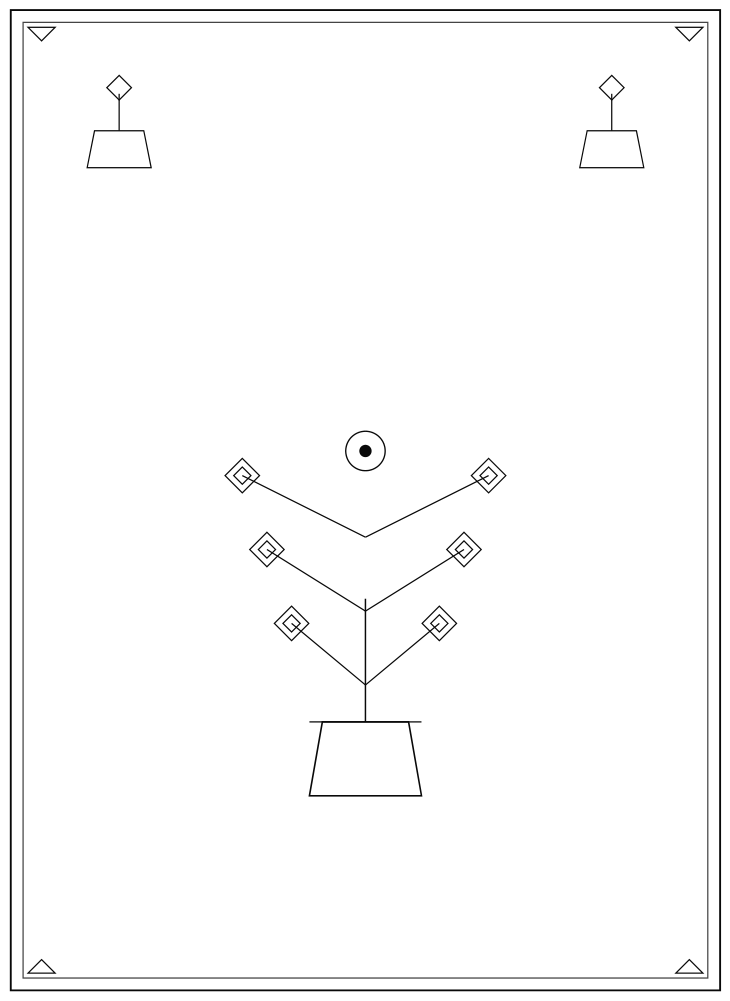
The Rose Pot grows from its base upward — three symmetric branches on each side, each one ending in a flower. Tawazun is this bilateral symmetry: remove one branch and the whole composition tilts. Add one more on one side and it tips the other way. Balance in Palestinian Tatreez is not decorative — it is structural. The Qawar motif encodes a philosophical position: beauty requires justice, and justice requires that what is given to one side must be given equally to the other.
قوار الورد ينمو من قاعدته للأعلى — ثلاثة أغصان متماثلة على كل جانب، كل منها ينتهي بزهرة. التوازن هو هذا التناظر الثنائي: أزل فرعًا واحدًا وتميل الصورة كلها. التوازن في التطريز الفلسطيني ليس زخرفيًا — بل بنيوي.
この模様は書籍の78ページで塗ることができます。
塗り方ガイド
Start at the pot base
Fill the trapezoidal pot — your most grounded, earthy color.
Work up the central trunk
The vertical line connecting pot to first branch — same color as pot.
Fill each branch pair symmetrically
Always work left and right branches of each level together — do not complete one side before the other.
Add the flowers at each tip
Each small diamond flower at a branch tip — your accent color.
Complete the top apex flower
The central top flower — your most saturated, celebratory color.
おすすめの配色
#006400#ffd700#f5f0e8#0a0a0a
文化的な背景
The Rose Pot (Qawar al-Ward) is one of the most widely shared motifs across all Palestinian regional traditions, making it a genuinely pan-Palestinian form. Its appearance in embroidery from every region — Gaza, Ramallah, Bethlehem, Jerusalem, Hebron, the Galilee, and the Negev — reflects the universality of the domestic garden in Palestinian life: every house that could have a pot of flowers had one.
The flower pot as a domestic object was central to Palestinian home culture — terracotta pots filled with herbs, geraniums, carnations, and jasmine were placed in courtyards, on windowsills, and at house entrances across Palestine. To encode the flower pot in embroidery was to carry the domestic world on the body: the courtyard, the herbs that flavored the cooking, the flowers given to guests.
The strict bilateral symmetry of the Rose Pot motif — three branches on each side, each ending in the same flower — encodes a philosophical position that Palestinian Tatreez scholars have noted: beauty requires justice. A pattern that is elaborated on one side and neglected on the other is not beautiful — it is incomplete. The Rose Pot's symmetry is not decorative; it is ethical.
振り返り
What does balance look like in your life right now — what is tipping, and what would restore equilibrium?
書籍の80ページに答えを書いてください。