
Leadership
قيادة
Qiyada · King's Crown · All Palestine
Le texte du livre est présenté en anglais et en arabe. Une traduction française intégrale est à venir.
La vidéo
Le concept
Leadership (Qiyada) in the Palestinian tradition is not domination — it is the carrying of responsibility for the community. A Palestinian leader walks in front not to be seen but to find the path. Four crowns extending from a center: leadership that moves in all four directions simultaneously.
القيادة في التقليد الفلسطيني ليست هيمنة — بل حمل المسؤولية عن المجتمع. أربعة تيجان تمتد من مركز: قيادة تتحرك في الاتجاهات الأربعة في آنٍ واحد.
Le motif
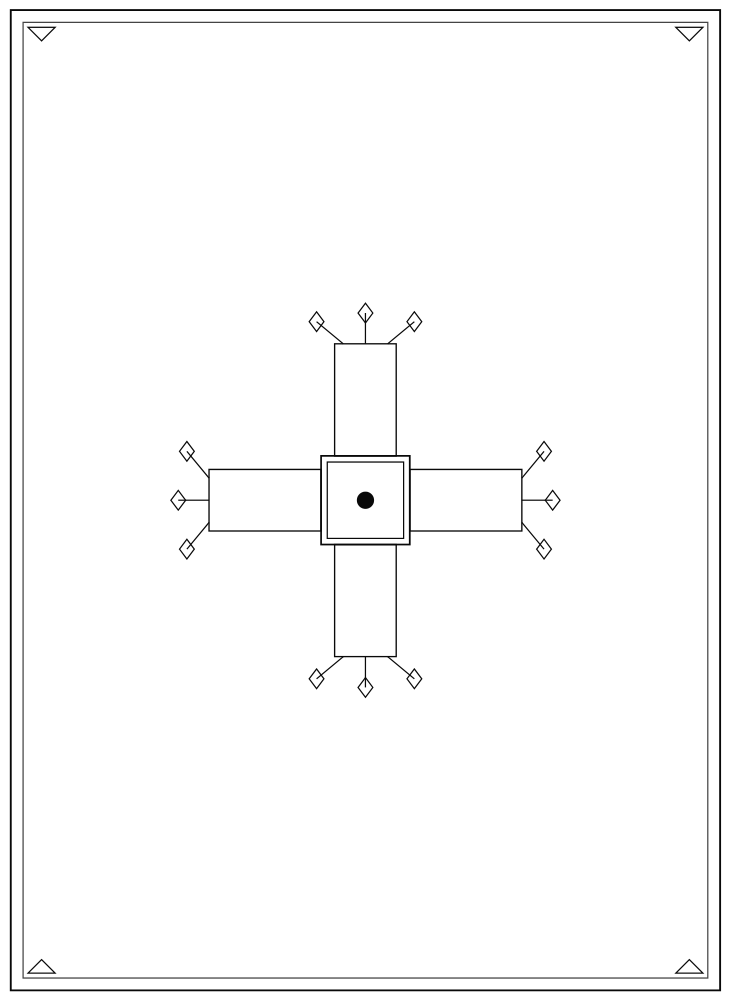
Four crowns extend from a central square — their bases touching the center, their tips reaching outward in the four directions. Qiyada is this extension: the leader who walks outward from the center toward all four horizons simultaneously, answerable to all four directions of the community. Palestinian leadership has historically been distributed — the mukhtar, the council of elders, the women's cooperatives. The four crowns are equal: no single crown is primary.
أربعة تيجان تمتد من مربع مركزي — قواعدها تلمس المركز، رؤوسها تصل للخارج في الاتجاهات الأربعة. القيادة هي هذا الامتداد: القائد الذي يسير للخارج من المركز نحو جميع الآفاق الأربعة في آنٍ واحد.
Coloriez ce motif à la page 146 du livre.
Comment le colorier
Fill the center square first
The anchor of all four crowns — your primary color.
Work each crown base
The rectangular base of each crown, one at a time — same primary color.
Add the three crown tips
The three pointed tips of each crown — work all three before moving to next crown.
Add the diamond ornaments
The small diamonds at each tip — your gold accent.
Complete all four crowns in sequence
Work clockwise — symmetry is essential.
Palette suggérée
#ffd700#b22222#f5f0e8#0a0a0a
Signification culturelle
The Crown (Taj) in Palestinian visual culture is primarily an agricultural symbol before it is a political one — the crown of grain at harvest, the crown of olive branches at the harvest festival, the crown placed on the head of the bride on her wedding day. Palestinian folk tradition associates the crown with the full expression of life's potential: the moment when what has been tended reaches its complete form.
Palestinian village leadership was traditionally organized around the mukhtar (headman) and the council of elders — a distributed form of governance that required consultation across the community before major decisions. The four-crown composition of the Taj al-Malik motif encodes this distributed model: four crowns, equal in size, extending in four directions, none primary. Leadership that serves all four directions is the only leadership that holds.
Contemporary Palestinian political leadership has operated under conditions of extreme constraint — occupation, siege, exile, and internal division have all limited the capacity of Palestinian governance to represent and serve Palestinian communities. The embroidered crown carries both the aspiration and the critique: this is what leadership should look like, extending equally in all directions, rooted in a center that holds.
Réflexion
What does leadership mean to you — when do you lead, and what does leading ask of you?
Écrivez votre réponse à la page 148 de votre livre.